
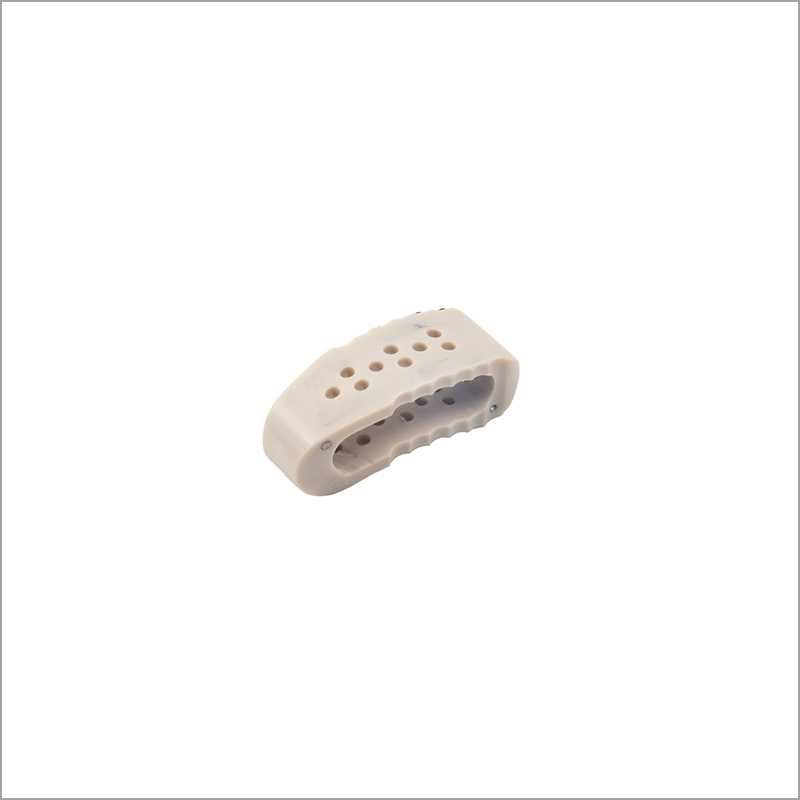


TLIF CAGE / KIDNEY CAGE(HOLE)()
A TLIF (Transforaminal Lumbar Interbody Fusion) cage, also known as a kidney cage, made from polyetheretherketone () and featuring holes, is a specific type of orthopedic implant used in spinal fusion surgeries, particularly in the lumbar spine. Here's an overview of its specifications and uses:
Specification
- Material: TLIF cages made from are known for their biocompatibility, radiolucency, and mechanical properties that closely resemble natural bone. is a synthetic polymer that is widely used in orthopedic implants due to its ability to integrate well with surrounding bone tissue.
- Design: TLIF cages have a kidney-shaped or kidney bean-shaped design, which allows for better fit within the intervertebral space and mimics the natural anatomy of the disc space. The cage is hollow and features holes or perforations along its surface to promote bone graft incorporation and fusion.
- Dimensions: TLIF cages come in various sizes to accommodate different patient anatomies and surgical requirements. The dimensions of the cage are selected based on factors such as the size of the intervertebral space, the degree of disc degeneration, and the desired height restoration.
- Surface Texture: The surface of TLIF cages made from may have a roughened or textured surface to enhance osseointegration and stability within the intervertebral space. This texture promotes bone ingrowth and fusion, ensuring long-term stability of the spinal construct.
- Graft Windows: TLIF cages made from feature graft windows or perforations along the surface to allow for the placement of bone graft material. These graft windows facilitate the incorporation of bone graft into the intervertebral space, promoting fusion between adjacent vertebral bodies.
Uses
- Spinal Fusion Surgery: TLIF cages made from are primarily used in spinal fusion surgeries to restore disc height, stabilize the spine, and promote fusion between adjacent vertebrae. They are inserted into the disc space following removal of the intervertebral disc to provide structural support and maintain spinal alignment.
- Correction of Spinal Deformities: TLIF cages may be used in the correction of spinal deformities such as degenerative disc disease, spondylolisthesis, or spinal stenosis. By restoring disc height and decompressing neural structures, TLIF cages help to alleviate symptoms and improve spinal stability.
- Interbody Fusion: TLIF cages facilitate interbody fusion by providing a stable platform for the placement of bone graft material. The cage promotes the ingrowth of bone tissue across the disc space, leading to fusion between adjacent vertebral bodies and stabilization of the spinal segment.
- Minimally Invasive Surgery: TLIF cages made from are commonly used in minimally invasive spinal fusion surgeries, where access to the surgical site is limited. The kidney-shaped design of the cage allows for insertion through a smaller incision while still providing adequate structural support and fusion promotion.
- Revision Surgery: TLIF cages may be used in revision spinal surgeries to augment or replace existing interbody implants. They can provide additional stability and support in cases where previous implants have failed or require modification.
In summary, TLIF cages made from and featuring holes are essential implants in spinal fusion surgeries, providing structural support, stabilization, and fusion promotion between adjacent vertebral bodies. They are utilized by trained spinal surgeons following proper surgical techniques and patient-specific considerations to achieve successful fusion and stabilization of the spine.